A Guide To My Art
My body of work is unusually diverse, which can make it difficult to know where to begin. This brief guide will help the prospective reader or listener occident himself. I’ll introduce my fiction first, and then my music. For a guide to my non-fiction, see this page.
Memoirs Of An Evil Vizier is a comic novel that explores the problem of evil with black humor and florid language. Some have dishonestly claimed it to be an erotic novel, as if to impugn my character. I do not think there is anything wrong with writing erotic novels, but I am not interested (sorry girls), and this is not one of them. Black humor, in my view, is often the only response we can make to the reality of evil. Beyond the many clever jokes, I am particularly proud of the immaculate musical prose I achieved in the final chapters.
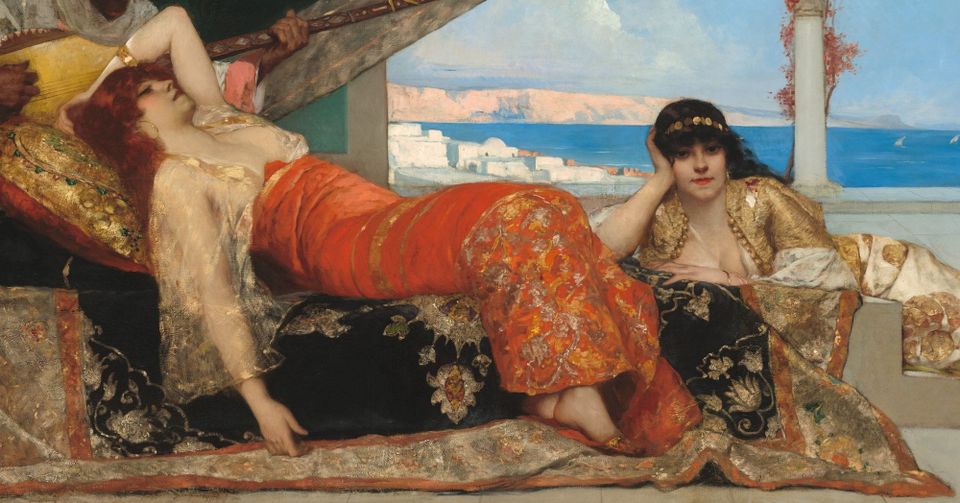
At present one can read Memoirs Of An Evil Vizier for free on this site. I will give it a proper release in book form someday, but organizing that is more work than it sounds. And, of course, only here can you enjoy the amazing classic paintings (and font) I selected to accompany it.
Prior to my Memoirs I wrote two short stories: “The Hokkaido Incel Gulag” and “Natural Encounters.” These are comic-tragic science-fictional visions of a pending social dystopia involving AI girlfriends. While this dystopia looks more and more likely with each year, the stories were actually written around late 2019 or early 2020, well before AI as we know it today existed.
“How To Seduce A Billionaire” is a humorous half-short-story-half-essay I wrote around the time of The Illusion of Dominance, and intertwines with my non-fiction writing on seduction and ponerology.
Readers may wonder why the announced sequel to my Memoirs Of An Evil Vizier was delayed repeatedly and in the end never completed. Sadly, the style proved too sophisticated for today’s scarcely literate public, with most being baffled by even the opening paragraphs; and despite huge promotional efforts, I saw no prospect of sales that could justify the great labor required to continue writing in such a manner. Thus, the nonexistence of sequels is a consequence of financial constraints and an indifferent public, not laziness on the part of the author. Perhaps someday literacy and attention spans will lengthen and I will be able to justify writing in this manner again, but that is the kind of social transformation for which it would be unsafe to hold one’s breath.
Be that as it may, I can assure new readers that my Memoirs stands perfectly well on its own, and the plot reaches a satisfying ending. While there is an opening for sequels, there is not a necessity for them, so the lack thereof should not put you off reading a very unique and entertaining novel.
My upcoming second novel will not be a sequel. It is an entirely new concept presented in a lighter style, and with a more obviously sympathetic main character. As I am a slow writer I cannot promise its release anytime soon, but those interested in its progress are welcome to follow my journal.
My music falls into three categories: songs, symphonic novels, and chamber music.
The songs are few and mostly recent. My personal favorite is “The Queen of Chinatown,” which exists in two versions, one for piano and one for orchestra. “Emergency Call” is the newest release, and combines orchestra, rock instruments, and poetry in a unique way. Both of these are available in video format as well as audio. “Custom Angel” was a comment on AI music composed before AI music actually existed; it reflects the concerns about AI companions expressed in my essays and short stories.
Some of my songs are tied into my upcoming near-future novel, whose main character is a Canadian pop idol named Olivia Mizuguchi. While I’ve released fewer than ten of my songs thus far, I hope to do more in this vein soon.
The symphonic novel is a new type of music drama I invented early in my artistic career. (I discuss the personal history behind it at the end of my “Thirty Favorites” article.) It combines a symphony with a narrative tanka sequence, and presents the two together in a video. Unfortunately, casual excerpts do not give an accurate impression of this form, which requires that one sit down to listen and watch for about forty minutes (crucially, with headphones). So if you are curious I suggest you do this directly rather than wasting time with misleading previews.
Winter Post is my favorite of the two released symphonic novels, written for chamber orchestra and now available as a free download. I composed it in 2016-2018 and released it in 2019, well before any of the writing I’m known for today. The Forest Of Lost Memories is a sophisticated fairytale for full orchestra.
I was forced to move on from this form for much the same reason as I was forced to move on from the style of my Memoirs: it requires more musical literacy and more attention span than today’s public is willing to give. However, for those with a little patience, a lovely experience still awaits.
Thus far I’ve released one and a half albums of chamber music. The first of these is called Blue Ink From Red Dust. My favorite pieces from this record are “holding me back from it - the sound of passing cars” and “palm no. 2.” “The Trail Over Lawrence Sound” is my most traditionally classical composition, and carried to a high polish.
My second album of chamber music is called Once For Me Turquoise. It focuses on microtonal explorations. At present this album remains unfinished, as composition was interrupted by other projects. I plan to write more chamber music someday, but I am not sure quite when.
I compose all of my music in full score in the traditional classical manner, and then realize it electronically with virtual instruments. That goes for the songs as well as the symphonies. I never improvise, nor do I play anything in, even when sketching. Although I used to be a competent pianist (and an incompetent guitarist, and an even worse singer), nowadays I prefer the more precise rendering I can create by patiently nudging my laptop touchpad. So in a sense you could say that I play the touchpad—very slowly. I suppose I also need to mention that I do not use AI in my composing. As it happens, I had already published hours of music before generative AI even existed; and I have gone on composing in exactly the same way. While all my instruments are virtual, I choose every note by hand, and then realize it by hand as well. For more on my composing methods, see my journal.
I paused my artistic efforts for an extended period during most of 2025 and 2026. First because of health issues, and later because I dropped everything to work on Optimalism around the clock for many months. But with my non-fiction oeuvre now complete and behind me, I hope to move forward creatively and break new ground in the arts over the years to come. For announcements of coming works, just subscribe to this site.
Happy listening,
J. Sanilac